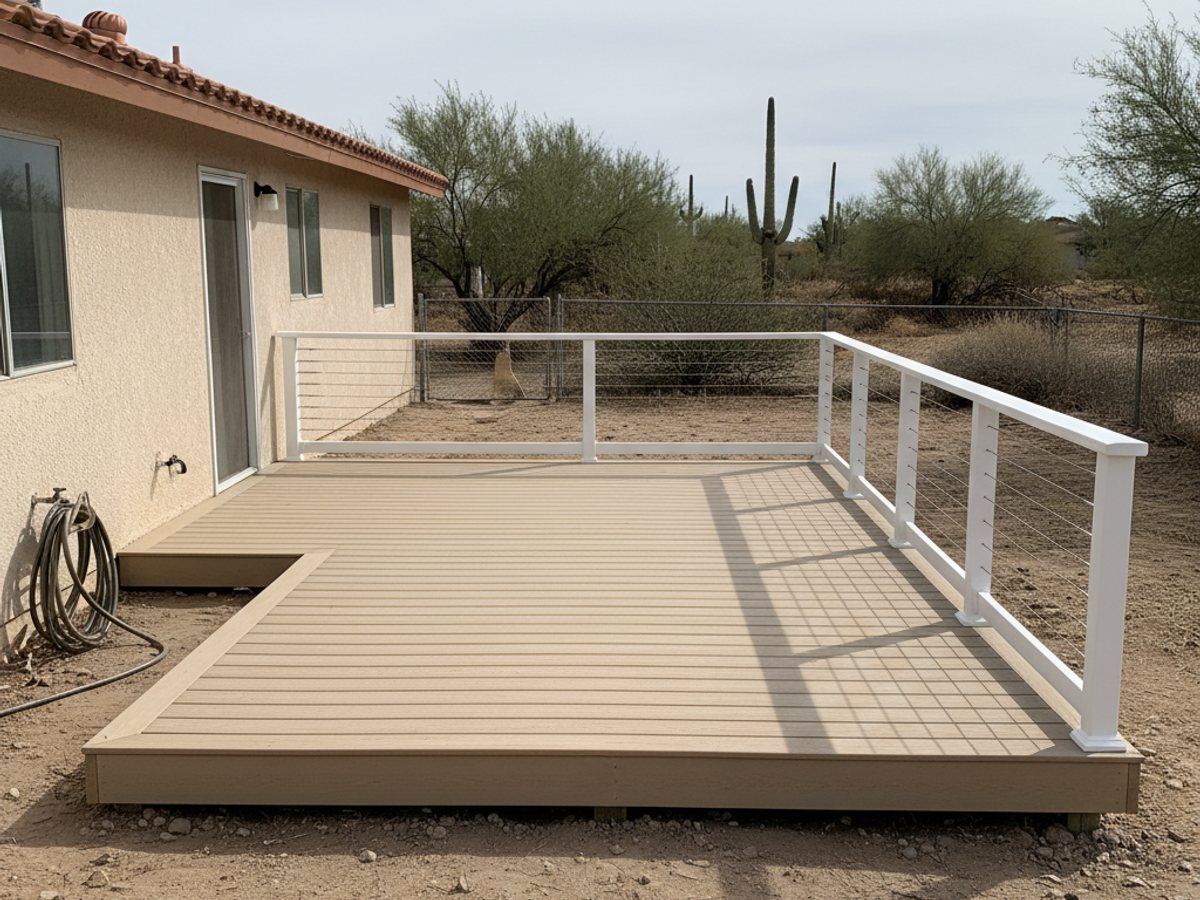
Marana has a lot of backyard concrete pads with nothing built on them, and a fair number of decks that were never inspected and are starting to show it. Picking the right builder up front saves you from being one of those yards. Here's what actually separates a good deck contractor from someone with a truck and a Saturday to kill.
Ask what they're doing about the caliche
A lot of soil around Marana, especially west toward Dove Mountain and out past the Tortolita foothills, sits on a hardpan layer called caliche. It's calcium carbonate that's cemented the soil into something closer to soft rock than dirt. A post hole digger bounces off it. A footing dug into caliche behaves differently than one dug into ordinary clay or sand, and a builder who's never hit it before will either underbid the dig or skip going deep enough.
Ask directly: how deep are the footings going, and what happens if they hit caliche at 14 inches instead of the 24 to 36 they were planning on. A contractor who's worked here has an answer already, usually an auger with a rock bit or a breaker attachment on standby. One who shrugs and says "we'll figure it out" is telling you he hasn't done this in Marana before.
Check the license and the insurance, not just the business card
In Arizona, residential contractors doing this kind of structural work need a ROC license, and you can look up the license number on the Registrar of Contractors' site in about two minutes. Confirm it's active and matches the name on your contract, not a cousin company. Ask for a certificate of general liability insurance and workers' comp coverage. If a worker falls off a second-story deck without comp coverage, that liability doesn't disappear, it usually lands on the homeowner.
A permit pulled through the Town of Marana or Pima County, depending on where your lot falls, is normal for most new decks and any deck attached to the house with a ledger board. Expect an inspector to look at the footing depth and rebar placement before it gets covered up, and again at ledger attachment and railing height before it's signed off. A builder who tells you permits are "a waste of time" is telling you he doesn't want an inspector looking at his framing.
Understand what our sun and monsoon do to a deck
June through August, surface temperatures on a south-facing deck board can climb well past what the air temperature says on the news. Untreated wood checks and splits faster here than in almost any other climate, and composite decking that isn't rated for high heat can warp or show gaps at the fasteners within a couple of seasons. Ask what brand and grade of composite they're proposing, and whether it carries a heat warranty for the Southwest, because not all composite lines do.
Then there's monsoon season, July into September, when a dry yard can take on an inch of rain in twenty minutes. A deck built without a drainage gap or with a ledger board that isn't properly flashed will trap water against the house siding and rot the sheathing behind it, and you won't see it until the damage is already three years old. Ask how they're flashing the ledger. If the answer is "we caulk it," that's not flashing, that's a temporary fix waiting to fail.
Get a written scope, not a verbal handshake
A real proposal names the footing size and depth, the joist spacing, whether it's 16 inches or 12 inches on center, the decking brand and board width, the railing style, and a rough timeline. It should also state who pulls the permit and who pays for it. Verbal estimates that change once the crew shows up are one of the most common complaints homeowners have about deck work anywhere, not just here.
Payment terms matter too. A deposit to cover materials is normal, something in the range of a third up front is common practice. A contractor asking for the full amount before a single footing is dug is a red flag worth walking away from.
Know your neighborhood before you design the deck
Older parts of Marana and the surrounding towns, homes built in the 80s and 90s, tend to have shallower setbacks and sometimes older electrical or gas lines running closer to the surface than you'd expect, which matters if footings are going in near a utility easement. Newer subdivisions closer to Dove Mountain and Gladden Farms usually come with an HOA, and HOAs here often have their own rules on deck height, railing style, and even stain color that are separate from the town permit process. A contractor familiar with the area will ask about HOA approval before design, not after the footings are poured.
If your lot backs onto a wash or has any grading that channels water toward the house, that changes where the deck's drainage needs to go, and it's worth raising before anything is designed, not during construction.
What to walk away from
- No license number, or one that doesn't match on the ROC lookup.
- A quote with no footing depth, no joist spacing, no material brand named.
- Pressure to skip the permit to save time or money.
- A price that's dramatically lower than every other bid, especially for composite decking, which has a real material cost that doesn't bend much.
- No mention of ledger flashing at all when the deck attaches to the house.
None of this is complicated once you know to ask. Most homeowners just don't know these are the questions until something's already gone wrong. If you want a second opinion on a bid you've already got, or you're starting from scratch, take a look at our deck builder work around Marana and the surrounding towns.